Burlap hearts

Burlap Heart Garland

I’ve been inspired recently by some beautiful things I have seen made by some very talented people, both on the interweb and in magazines, using burlap, linen, lace and vintage buttons. Little purses, bags and decorative objects, all just lovely :) It occured to me that a burlap or linen heart garland could be something special.

I was having a sort out (I usually am ;) ) in my bedroom, mostly in an attempt to unearth a space in there to use as a craft area, when I found a bag with some bits of fabric in that I’d used for making cushion covers about ten years ago. In there was some burlap. Hooray!! I got some lace and some vintage style buttons off Ebay and got thinking.

The first issue was how to actually make the hearts. Burlap is very thick and not really all that bendy, compared to craft cotton. It also frays quite badly, so making squishy hearts like I did for the other heart garlands was not going to be possible. So I decided instead to back each heart with interfacing to reduce fraying, then join each pair of hearts by sewing them together on the right side, then stuffing.

With that sorted out, I could turn my attention to decorating the hearts. I wanted to make each one different. For the first one, I layered two pieces of lace. Then I gathered a piece of broderie anglaise until I had enough to make a circle, then I attached a little button and sewed it onto the middle of the heart.


In my bag of goodies from Ebay, I found some pale pink scalloped lace. For this heart I used two pieces of scalloped lace and covered the join with a piece of cream lace. I chose three different buttons and sewed them to the middle of the heart.


I took the same approach with this one: three pieces of lace layered, 2 shiny buttons and a lace flower made in the same way as the broderie anglaise one.


To make this one slightly different, I gathered some borderie anglaise and sewed a layer of lace to cover the raw edge at the top.


For the last heart, I cut some flowers out of a piece of lace and sewed them on, using a button as a focal point in the middle of the heart, and a small piece of lace at the bottom (which I unfortunately did not manage to attach straight!!).


With the fronts decorated, my next task was to attach the loops. I used some jute twine to compliment the burlap, sewed to the hearts at the back of each pair. Then I sewed each pair of hearts together and stuffed them using polyester filling. To assemble the garland, I cut some lengths of twine and plaited them together, adding the hearts as I went.

Now I’ve finished it, I’ve got lots of other things planned to make! I’ve got two more heart garlands ready for assembly, one pink and one blue, both will say “BABY”. I had an idea to make personalised garlands too, with a child’s name instead of “BABY”. I need to get making kits for Christmas decorations too, and I want to make a changing bag for the baby, ideally before he arrives!! He’s due in 7 weeks so I’ll have to get on with it :)

Posted in Uncategorized | Tagged , , , , , | Leave a comment

Maternity Clothes

I haven’t posted anything for a long time because I have had awful morning sickness and I’ve not felt up to making anything. People who smugly declare that “pregnancy is not an illness!!” need a poke in the eye. Okay, it’s not an illness, but it can make you feel pretty ill. Three months of sitting on the sofa trying not to vom is not fun.

Anyway, I haven’t thrown up for a few weeks now. I’m just tired and, as people keep telling me, I’m huge and my clothes do not fit any more, so I’ve made some! I know I have said this before, but I have no formal training in this area and a few years ago I would never have believed that I could make my own clothes, but you know what? It’s perfectly possible, all it takes is patience, planning and some trial and error. The end result is clothes you like that fit properly, and you also have fun making them :)

Table Cloth Skirts

I love these, not least because they me feel like me feel like Maria Von Trapp or that girl from Enchanted. They were actual table cloths that I bought off Ebay, and although they were barginous bacause the cost of posting anything is so high now, I would have been better off raiding charity shops instead.

They were very easy and quick to make. I folded each table cloth into quarters and decided how long I wanted them to be by measuring from my hip to just below my knee. Then I measured from the edge of the table cloth and marked it off at the correct length. The next part was a little tricky. Using a plate as a guide, I cut a circular hole in the middle. So now I had a circular piece of fabric the right length from under my bump.

Next I took a piece of jersey fabric, wrapped it around my middle and pinned it, then sewed up the seam, making a stretchy waistband.

Returning to the table cloth with a hole in the middle, I put in two rows of stitches around the hole and gathered it until it was the same diameter as the waistband.

Then I folded the waistband in half to make it narrower, joined the raw edges and voila!! One skirt with a lovely stretchy waistband.

With the yellow one, I added a net underskirt to make it foofy.

Evening Dress

I needed a dress for Husband’s black tie work thing and I was reluctant to buy one as maternity frocks are expensive, so I decided to make one. Husband was not keen on this idea to start with: “You can’t turn up in something you’ve made!!!” but he soon quietened down. When I quizzed him, he said, “Well, you won’t look as stupid as X with his candy striped waistcoats.”

I was inspired by a picture of Angelina Jolie in a beautiful green dress. It was very simple (and probably cost a fortune!), but I believed the shapes would lend themselves well to somebody bulbous. I bought some navy blue tafetta and, after much thought, I had a plan.

The key thing was the gathering, easy enough to do and comfy for the wearer. The front is two triangles, gathered underneath to accomodate boobs, then joined together, with a rectanglar panel at the back at simple shoulder straps. The skirt is two large rectangles, the back one gathered a little and the front one gathered a lot.

I made nine organza flowers and attached them to the side. The dress is lined and so comfortable. I didn’t need zips or anything. Unfortunately it was so cold I also had to wear leggings, a cardi and a pashmina or I would have frozen. :)

Cotton Dress

I know, it looks like a nightie, but I can assure you it doesn’t on!

I was trawling the internet looking at maternity clothes when I came across a pretty dress that I really liked. Unfortunately I did not like the price, or the fact that it was made of linen (I do not iron), so I decided to have a crack at making my own.

I decided to cut it on the bias. It appeared complicated but was actually very easy. All it means is that when you line up the up and down of your pattern, instead of the warp and weft threads going up and down and side to side, they are on the wonk like a saltaire cross. It uses up a more fabric but it drapes better.

I also decided that I did not want to use facings or a lining, so I made some bias binding, which aslo sounded scary but was very easy and finished off the neckline nicely without anything needing ironing.

The front is two pieces plus sleeves. To get it the correct size I pinned some bits of tatty old fabric to myself and drew on it with a felt pen. I then cut it out and drew round it onto greaseproof paper, allowing 2cm for seams, to make a pattern.

The bump allowance in the skirt is formed of nine pleats, so I put some pleats into a scrap piece of fabric, then worked out the sizing by once again pinning it to myself.

The back is made from a single piece of fabric. The shaping of the top was difficult. I took some approximate measurements and used the shape of the front as a guide for the armholes. I pinned more fabric to myself just to check that it would fit and made some minor adjustments.

Cutting it on the bias meant that the skirt was not long enough, so I added some extra panels at the side.

I am very happy with the results :) The dress is very comfortable, cool in the heat but fine with a cardi when its colder. And better still, I don’t have to iron it :)


Posted in Uncategorized | Tagged , , , , | Leave a comment

Bag Tutorial

This tutorial has taken a little while coming out of my head onto my computer. It would appear that I have taken up throwing up for Lent. It also started a week early, perhaps following some other calender. Grim. Anyway… a bag tutorial!! No pattern needed and it should work for bags of various shapes and sizes.

You will need:

  • Fabric for the main part of the bag (I used 1 fat quarter)
  • Fabric for the lining
  • You may also want some fabric in a contrasting colour
  • Fusible interfacing
  • Needle and thread or sewing machine
  • Tape measure or string and a ruler
  1. Firstly you will need to decide how big you need your bag to be. Will it be a tiny bag just for your purse and phone? Or do you need it to be big enough to hold an A4 folder? Or nappies and wipes? Or the kitchen sink? You might find it helpful to get the stuff you want to put in your bag to give an idea of how big you need it to be. Remember to allow extra fabric for seams too! When you have decided, you will need to cut four rectangles about 7 cm wide. This is the part that holds the whole bag together.  The length of them will depend on how big you need the opening of your bag to be. Which fabric you want to use is up to you, main or contrasting. I used four rectangles of the main fabric approximately 7cm x 25cm.

    The width of the main piece is longer than the rectangles

    Then you will need to cut the pieces for the main part of the bag, so either two pieces from the main fabric or one piece folded in half. The important thing here is to ensure that the top edge is 1/3 to 1/2 longer than the rectangles. Iron some interfacing onto the wrong side.


2. From the lining fabric, cut a piece that is the same size as the main bag piece.

3. With your sewing machine set to the longest

2 rows of stitches along the top edge

stitch it will do, sew two separate rows along the top edge, close together. Repeat for the other top edge. If you are using a needle and thread, sew two rows of running stitch. Don’t backstitch the ends! You need them free!!


4. Now firmly grasp the top two threads on

Width of bag is now the same as the length of the rectangle

one side and pull to gather the fabric. When the width of the fabric is the same as the length of the rectangles, tie the ends together. Try to spread the gathers out so that they are even. Repeat for the other top edge, then repeat the whole process for the lining.


5. Now with the wrong sides together, sew

Sides sewn up

up the sides of the main part of the bag. Trim the seams and turn the right way out. Repeat for the lining, but leave it wrong side out.


6. Now take two of the rectangles and sew

Short sides of rectangles sewn together

the short edges together to make it into a circle. Repeat for the other two rectangles.


7. Fold up the long edges, pin and press.

Rectangles ready for bag assembly

Pop one inside the other, wrong sides together, with the seams matching.


8. Put all this to one side because we are going to do the straps now You will need to decide how long you want them and how wide is comfortable for you. This is where the tape measure comes in! Put it over your shoulder or your pushchair, or hold it, and decide where you want the bag to dangle. Then you will need to cut four pieces of fabric, two for each strap, either from the main or the contrasting fabric. Remember to allow a bit extra for seams! The easiest thing to do is to cut all the bits the same size, fold in the raw edges, pin and press. Then pin two together, wrong sides facing, and sew along each of the long edges.

If you want to be fancy, cut two pieces the

A completed strap

desired length (allowing a little bit extra) and twice as wide as you want the straps to be from contrasting fabric. Fold in the raw edges, pin and press. Cut two pieces the same length from the main fabric at your desired width. Fold in the raw edges, pin and press. Then pin the narrower strip so that it covers the raw edges of the wider strip. Sew along the long edges of the narrow piece.


9. Now is the tricky part. Put the ends of the

Pin the straps inside

straps in between the two circles that were rectangles and pin at the top. Make sure that they are close to the seams as they will be lined up with the sides of the bag.


10. Put the lining inside the outer of the main part of the bag. Next attach the circular ex-rectangles. Pin the outer one to the outer of the bag and the inner one to the bag lining. They should cover the stitching but you don’t want the main bits poking out of the top :) Ideally the ends of the straps should be between the lining and the bag outer. Then sew along the top of the rectangles and again along the bottom. Trim the threads and you have a new bag!!

If you make something, please photograph it and post it with a comment. I’d love to see them!

Posted in Uncategorized | Tagged , , | Leave a comment

Beautiful Day

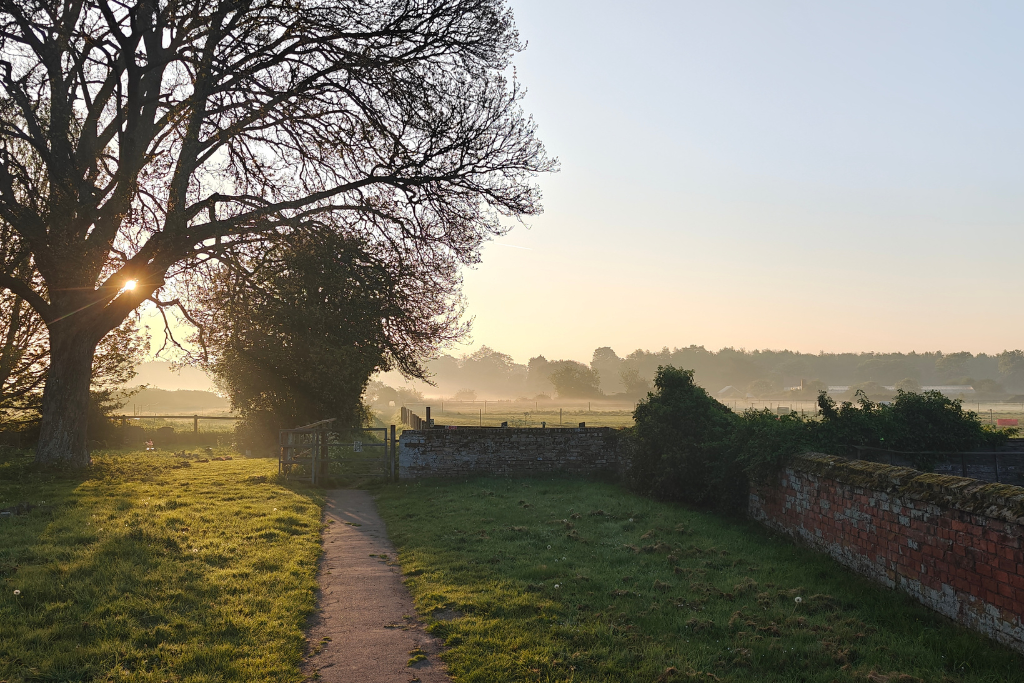
This is not really a craft post. I’ve got one in the pipeline ;) about making bags without a pattern, but I’m feeling a little tired at the mo and my brain’s having a craft meltdown: too many projects on the go, I’ve still not sold a single thing on Etsy and I am always busy taking care of my three little boys. Anyway, the walk back from taking Boy 1 to school was so beautiful this morning, I thought I would share it.

Gorgeous, isn't it?

Boy 1′s school is two miles away, in the next village. We usually catch the bus there then walk back. Since Boy 1 started school almost eighteen months ago, the bus service has improved and I could bus it back too, but I actually enjoy the walk. It’s lovely living in the country, the air is clean and there is always lots to see, mostly nature and tractors. Once we turn off the not so busy but 60 limit road, we wind our way along country lanes the rest of the way home.

Norfolk or Narnia?

Boy 3 is happy enough riding back in his pushchair. At least he his now. I did have some unpleasant mornings when he started screaming about half way back and didn’t stop until after we had got home. I guessed he was probably cold. He refused to wear a hat or scarf or gloves and he hated the cosytoes. Anyway, to prove that two year olds are able to understand what you tell them, he now wears a hat, scarf and gloves, and instead of the cosytoes, he has a blanket over his little legs that attaches to the pushchair by means of elastic and buttons. He’ll actually ask for his gloves now if he’s cold :) Much better. No screaming :)

This is not my house, but sometimes I wish it was :)

Boy 2 has a buggy board, so the mornings he’s not at nursery he can hitch a ride if he doesn’t want to walk. He has walked the whole way several times, but it takes us a very long time :) The world is such a fascinating place when you are little :)

This morning it was so beautiful: a perfectly clear, crisp winter’s day. The sky was cloudless and there was just enough snow to cover everything but not so much it was impossible to get anywhere (we had 15cm at the weekend, it was horrendous!! Boy 1′s school was not closed either, so we had to fight our way through it). The snow was actually sparkling, like there were tiny diamonds mixed up in the white icing sugarness. It was like walking through a Christmas card. Scenes from The Lion, the Witch and the Wardrobe were running through my head. Breathing the crisp, clean air, with the snow crunching underfoot and the snow sparkling in the sunshine, I felt glad to be alive.

A scene off a Christmas card

People who drive everywhere miss out on so much. For us the school run is an adventure. Boy 1 loves buses and the bus drivers are his friends. On the way home Boys 2 and 3 and I see so much. We stop and watch tractors, farmers an other people working in the fields. We see birds, cats, foxes. We see the seasons change and what it means for animals, plants and people. We’ve seen the buds gradually become leaves, blossom become fruit, leaves turn brown, red and gold and birds migrating. We’ve seen farmers planting and farmers harvesting. I wouldn’t swap any of this for a car or the skills to drive it.

Our nearest "hill", 4 metres above sea level

Most importantly the boys gain a sense of their neighbourhood and a sense of independance and resourcefulness often denied to children who are driven everywhere. They know their neighbourhood. They know where places are, how to get to them and how long it takes (at least Boy 1 does!). We speak to our neighbours, the dog walkers, the people going  to the bakery and the newsagents. They know their communities in a way that kids who are driven everywhere do not. It’s not Tesco that’s killing our communities, it’s cars!! Even high school kids near us are driven to school, when they could walk or catch the bus! Having a non-driving mum means that my boys are growing up knowing that, when they are old enough, they will be able to get themselves around without having to rely on a parent driving them everywhere.

I hope this is what my boys remember about being children: the bus trips, the walking, the seasons changing, the conkers, the puddles, the sun, the rain and the snow. Leave the car at home folks, get out in it! I can’t recommend it enough :)

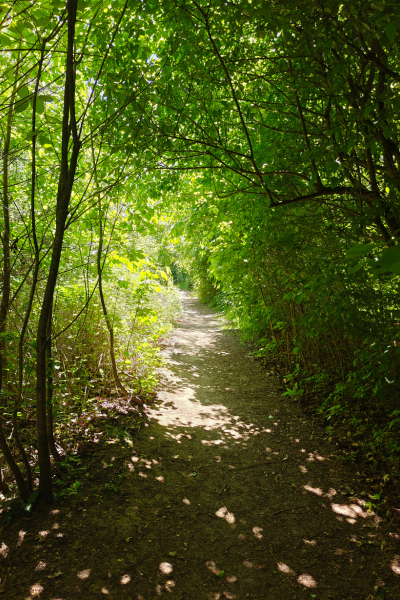
The Tunnel of Trees

Posted in Uncategorized | Tagged , , , , , | Leave a comment

Dino Hat Tutorial

Boy 3 wearing his dino hat

Whenever the boys and I are out, people always remark on the dinosaur hats and are almost always stunned when I tell them that I made them myself. :) Yet they are suprisingly easy to make. Although there are people out there who are very skilled at designing things and making patterns, I am not one of those people. The extent of my training was my mum teaching me how to use a sewing machine when I was ten. :) What I have discovered though (and what I’m going to share with you now) is that it is actually possible to make all sorts of things either without a pattern or with a very simple pattern that you can make yourself, even if, like me, you can’t really draw. :)

Anyway, I’d decided that I wanted to make dino hats for the boys and my nephew, but I didn’t want it to look like they had killed some dinosaurs and turned the heads into hats. I couldn’t find exactly what I was looking for, so I came up with this.

This is what you will need:

  • Some large sheets of paper. I like to use greaseproof paper, but newspaper or A3 copier paper will do.
  • A pencil and eraser
  • Some tin foil
  • Fleece fabric in 2 contrasting colours
  • Basic sewing equipment


1. Find the head that you are making

The hat will fit and Boy 1's little brain will be safe from aliens :)

the hat for and wrap it in tin foil.


2. Carefully remove the tin foil hat from

Squashed hat

the head and squash it flat (the hat not the head :) ). Try to squash it in such a way that the squashed hat is the sideways profile of the head, with the front on the left and the back on the right.


3. Now draw round the squashed foil hat

Basic hat shape with extra cm all the way around

onto the large piece of paper. Now you can be sure that the hat will fit! Draw round it again, this time allowing an extra centimetre all the way round. This is to allow for seams.


4. Now draw simply a dinosaur head on one

It's starting to look dinosaury!

side and a tail on the other. If it looks wrong, rub it out and have another go. When you have something you are happy with, draw round it again allowing an extra cm. Don’t worry if it is not perfect, quirkiness is part of the appeal of handmade.


5. Now draw some spines. How many will

The spines are all just triangles

depend on the size of the head the hat is for. I gave my dinosaur 9 spines, 6 larger ones along the body and three smaller ones along the tail.


6. Now you need to make the pattern for

2 triangles for the spines

the triangles, so draw 2, one a similar size as the larger ones and the other similar in size to the smaller ones. Don’t forget to draw round them again with an extra cm!


7. The pattern’s almost done now. The last

Use the thread to measure between the xs

part to draw is the little pointy pear shap that will give the dinosaur’s head a 3D shape. To make this part, draw an x on the dinosaur’s nose and another x on the back of its head. Using some thread or string, measure the distance between the two xs and cut or mark the thread.


8. Now draw a straight line the same

This little piece will give the dinosaur a nice, chunky little head

length as the piece of thread. Then draw a sort of teardrop shape, pointed at both ends. To get each half the same, draw one half, then fold the paper in half along the line and trace it. If you are using newspaper, cut around it roughly, fold in half and then cut it out properly, like you would make a chain of paper people :)


8. Now cut out the pattern pieces, pin them to the fabric and cut them out. For the main part of the hat, the stretch will need to go from left to right rather than up and down, so stretch the fabric before you pin the pattern pieces on. You will need to cut 2 of the main hat shapes and the little extra head part from the main colour, and from the contrasting fabric, 2 triangles for each spine. For my 9 spines, I cut 12 larger triangles and 6 smaller triangles.

9. Now we can get sewing! First of all the

Trim the seams but don't cut the stitches!

spines. Pair the triangles up and sew them along 2 sides. Then trim the seams to avoid bulging and cut the top flat. Then turn right side out.


10. On both the main hat pieces embroider

Embroider legs on both pieces

some legs.


11. With the wrong sides together, pin the

Pin the little head piece to one of the main hat pieces

little head piece to one of the main hat pieces. The fat end needs to be at the front of the dinosaur’s head. Then sew it.


12. Now take the triangles that you have sewn

Arrange the spines with the largest ones in the middle

together and arrange them in a way that you like.


13. Now we’re going to make a little sandwich.

The spines are pinned in place

Take the main dinosaur shape that you have sewn the little head piece to and arrange the spines in the order you have decided, upside down, on the right side. The open ends of the spines will need to be lined up with the dinosaur’s back. Pin in place.


Now take the other dinosaur piece and put

Nearly ready to sew up

it on top of the bit with the spines on, the right side of the fabric facing inwards. Match the edges up as well as you can.


Pin it together. Remember you have the

Constructing the head is a little bit fiddly

extra bit for the head. When you get to the head, pin the main piece to the little head piece like you did earlier.

Here’s a little tip: before you sew it up, make sure that the ends of the spines are poking out of the edge of the sandwich, otherwise you might find that you’ve missed a bit and you’ll have to do a repair job with a needle and thread.


14. Now sew it up. You won’t be able to sew it in one go because of the dinosaur’s head. Take your time and do it carefully to minimise the chances of holes in the seams. I’ve been there. It’s v. annoying.

15. Once it’s all sewn up, turn it out the right way. Removing as many pins as you can first will reduce the likelhood of stabbing yourself in the finger.

16. If you’ve got this far, well done!! The last

Finished!!!

thing left to do is hem the bottom of the hat.


So there you go. One hat made from a do-it-yourself pattern. If you make a dino hat, please leave a comment and a link to a photo. I’d love to see them. Just have a go, don’t be scared!! What other kinds of hats can you make using the same basic principles? Hmm, butterflies, cats, a whole menagerie of hats!!

Raahhhh!!!


Posted in Uncategorized | Tagged , , , , , , , , , | Leave a comment